Last Topic

Tampilkan postingan dengan label Security. Tampilkan semua postingan

October is National Cyber Security Awareness Month

Kamis, 21 Oktober 2010
This October marks the seventh annual National Cyber Security Awareness Month sponsored by the Department of Homeland Security. This month encourages people to be aware of computer security and to take steps to help keep their information secure. 

Here at The Tech Desk, we have posted articles about computer security, including news about new anti-virus software and tips for avoiding online scams. Here are several other excellent articles on how to stay safe online.
By using some of the simple tips in these articles, you will have a safer online experience. 

    Setting a Password to Open an Excel Workbook

    Sabtu, 29 Agustus 2009
    One of the students in my Intermediate Excel class this week asked me how to set an Excel workbook so a password is required to open or modify it. This is fairly easy.

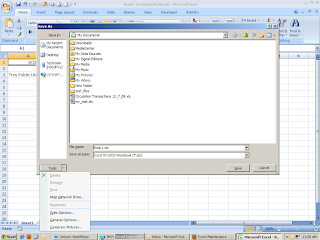
    When you have finished creating your Excel workbook, click on the Office Button in the upper left hand corner, then click on Save As. On the Save As dialog box, click on the Tools button on the bottom left side of the screen. Then click on General Options.

    On the General Options box, you can set a password to open or modify the workbook. It is critical that you remember your password. If you forget your password, Microsoft cannot retrieve it. You can also set a recommendation that the file be opened as Read Only.


    Most Dangerous Search Terms on the Web

    Rabu, 10 Juni 2009
    You are a smart computer user. You don't open suspicious email, you keep your firewall on, and you don't visit sites common knowledge says harbor viruses and spyware. Or do you?

    According to a recent study by McAfee, Internet searches for such terms as "lyrics," "myspace," and "free music" often return sites that house malware that can infect your computer. Why do these sites so often house malware? Hackers realize that people consider these sites "safe," so it is more easy to place items that look safe, but in reality download malware to your computer.

    You can read the complete study here.

    Men and Women Use the Internet Differently

    Rabu, 15 April 2009
    Men make up a minority of the overall Internet population – those who access the Internet at least once a month from any location. There are 95.9 million men online (48.2%) and 103.2 million women online (51.8%).

    However, according to eMarketer, men go online more often; are more active on social networking sites; read and write more blogs; listen to more podcasts; stay on for longer; and are not as bothered by "websites cluttered with ads" as women are.

    The U.S. male Internet population is evenly split between those under and over the age of 35, with the largest group falling between 35 and 44. "Marketers may be overlooking a valuable demographic if they target only 18-to-34-year-old males. Advertising messages steeped in college humor and sex do not resonate with the millions of male Internet users who are researching products and services — and jobs — while shopping and connecting with friends and family," writes eMarketer.

    This report confirms earlier reports on how men and women use the Internet differently. In 2008, four reports compared the behaviors of men and women online:
    [via ars technica]


    Microsoft to Fix IE Security Hole

    Rabu, 17 Desember 2008
    Microsoft Corp. is issuing an emergency fix for a security hole in its browser, Internet Explorer, which was reported yesterday.

    The hole has exposed millions of users to having their computers taken over by hackers.

    According to The New York Times, Microsoft said it plans to ship a security update, rated ''critical,'' for the browser on December 17. Those with the Windows Update feature activated on their computers will get the patch automatically.


    Microsoft said it has seen attacks targeting the flaw only in Internet Explorer 7, the most widely used version, but has cautioned that all other current editions of the browser are vulnerable.

    Microsoft Admits Security Flaw, Reports CSM

    Selasa, 16 Desember 2008
    According to Andrew Heining, writing on the Christian Science Monitor's technology blog Innovation:
    There’s a critical security hole in Internet Explorer, the world’s most popular web browser.

    The unpatched vulnerability, first discovered by hackers and recently acknowledged by Microsoft, could allow someone to gain access to a computer through a website that executes a malicious code. Some 10,000 sites have been compromised so far, putting passwords, financial data, and other sensitive information at risk.

    In a lengthy security advisory memo on its website, Microsoft urges users to change their “Internet zone security setting” to “high” and to run the browser in “Protected Mode.”

    According to the post, savvy surfers can protect their machines, "[b]ut the easier solution may just be to drop IE."

    With alternate browsers Firefox and Google's Chrome gaining in popularity, Microsoft's dominance of the browser market may be at an end.

    Last Photo